


On Friday the 11th of September, the US Bureau of Labor Statistics published August's inflation report, and the figure that ran in every headline was 3.4% — the rise in consumer prices over the past twelve months. The figure that ran in no headline at all sits one line beneath it. Take food and energy out of the shopping basket and you get what economists call core inflation (the same basket exactly, minus the two items whose prices swing hardest and fastest, for reasons that have little to do with the temperature of the economy): 2.4%, down from 2.5% the month before, and the lowest reading since the beginning of 2021. Five days later, with that report sitting on its desk, the Federal Reserve raised interest rates — for the first time since 2023.
And that was only Wednesday. Between that Friday and the Friday that followed it we also got a rate rise in Tokyo, gasoline at $4.319 a gallon, chip stocks falling almost 6% in a single day, and the interest rate on ten-year US government debt touching 5% for the first time since October 2023. When all of that lands inside eight days, the mind immediately goes looking for one story that explains all of it. This time the story genuinely exists, and it is not a story about oil and it is not a story about chips — it is a story about one price that sits underneath every other price, which is the price of money itself.
It starts, as it has all year, at the Strait of Hormuz — the narrow sea passage at the mouth of the Persian Gulf, through which a fifth of the world's oil used to sail. Because of the war with Iran it is almost entirely closed: traffic through it fell to 4.9 million barrels a day in the second quarter of this year, from 21.6 million in the last quarter of 2025 — what the International Energy Agency called the largest supply disruption in the history of the world oil market. Then, around the 11th of September, a drone attack launched from Iraq shut down the Saudi pipeline that had been carrying 7 million barrels a day to the Red Sea, bypassing the strait entirely. Oil ended the week trading somewhere between about $102 and $109 a barrel, depending on which barrel you measure and at what moment of the day. Prices are no longer climbing — they are simply sitting at a level that has become a fact of life.
From the barrel it travels to the gas station, and that is where Americans actually met this week. The national average for a gallon of regular gasoline reached $4.319 — 16.2 cents higher than a week earlier, and a dollar and 15 cents higher than a year ago. Diesel reached $6.285 a gallon, up about two and a half dollars in a year, the highest price ever recorded. Diesel matters more than gasoline because almost nothing you buy reaches you without it — the truck, the train and the ship all run on it — so its price sits quietly inside the price of everything on a shelf. On how a raw-material price makes its way to the checkout, and how long that takes, I wrote a whole letter a few weeks ago, and this is the week to read it: From the Commodity to the Store.
And from the gas station it walks straight into that inflation report. Energy prices are up 16.3% over the past twelve months, and gasoline by itself explained more than a third of the monthly rise. In other words, the entire distance between the 3.4% that made the headlines and the 2.4% sitting underneath it is energy.
Which raises the obvious question: did the Federal Reserve raise rates because of oil? I don't think so, and the reason is that 2.4%. If the Fed were reacting automatically to a fuel price, it would be breaking a rule it has stated out loud for decades — you look through a supply shock, because raising the price of money in Washington does not put one more barrel on a tanker. The committee voted 12 to 0, with no dissents, and lifted its target range (the Fed doesn't set a single number but a floor and a ceiling, and steers the actual rate between them) by a quarter of a percentage point, to 3.75%-4.00%. Its official statement says plainly, "Inflation remains elevated. Today's policy action will support a timelier return to the Committee's 2 percent goal," and on jobs, "Job gains have kept pace with the workforce, and the unemployment rate has changed little." At the press conference, Chair Kevin Warsh added, "The plain fact is that inflation is too high and has been too high for too long." Personally, I read the combination this way: the Fed is not fighting oil, it is trying to get out in front of it — before an expensive tank of gas turns into wage demands and into an expectation that prices simply keep rising — and it is moving now precisely because the job market is strong enough to absorb it. Anyone who tells you the Fed hiked because of fuel has to explain why the measure that strips fuel out is falling.
And now to the part where money genuinely gets more expensive. The interest rate on a ten-year US government bond touched 5% this week, the highest since October 2023, and it did not get there because of Wednesday. Here is the mechanism, because nobody announces a rate like that: the government sells a bond (a written promise to repay a known sum on a known date), and from that moment it trades in the market like anything else. When there are fewer buyers its price falls, and whoever buys it cheaply collects the same fixed future payments for a smaller outlay — so the effective interest rate, the yield, rises. It is the product of how nervous the buyers are and of nothing else — and this week they were watching oil and the pile of new debt about to be sold, not Washington: the thirty-year rate barely moved going into the decision, fell the day after the hike, and rose again on Friday on an oil headline. On why the central bank controls the price of money for one night while the market sets it for thirty years, I devoted a whole letter: When the Ground Under the Money Market Starts to Shake.
And from there it lands somewhere you can feel, through a mechanism simpler than it sounds: a lender pricing a 30-year mortgage prices it off the yield on the ten-year government bond, because ten years is roughly the real life of such a mortgage before it is paid off or refinanced — so when the bond yield rises, the mortgage rate follows it up. The average rate on a 30-year fixed mortgage reached 6.95% in Thursday's weekly survey, against 6.76% a week earlier — a fourth straight weekly rise, and 0.69 of a percentage point above the 6.26% of a year ago. Mortgage applications fell 2.7% in response. So far there is a clear path connecting all of this news: uncertainty, local and global, raises interest rates — that is, the cost of money — and produces inflation, which in turn feeds the next rise in the cost of money through further hikes, and so everything gets more expensive. From fuel, through goods, all the way to the mortgage.
And now let's talk about the stock market, and about what happened to chip stocks this week — because they too, it turns out, hang on the price of money. On Monday the Philadelphia semiconductor index fell 5.9% in a single day, with memory-chip makers leading the way down. The trigger was an essay: Anthropic's chief executive published a piece arguing that safety research is not keeping pace with new capability, and two executives who compete with him directly — Sam Altman of OpenAI and Elon Musk of xAI — publicly backed him. But an essay doesn't take a whole index down six percent, so I checked three possibilities. Maybe investors fear these companies won't be able to finance their enormous investments in a world flooded with borrowers? That sounds right, and there are real signs of it — Oracle was downgraded in July to one notch above junk, and a data-center bond deal was pulled from the market. But on Monday itself the corporate bond market didn't move, and the stocks that led the fall were the memory companies, which carry almost no debt. So maybe it's the cost of the financing itself? That's real too — an investment-grade bond was issued this month at 6.6%, while the government pays around 5.7% for a similar term, which is a good rating paying risky-debt interest — but the gap between what a company pays on its debt and what the government pays actually narrowed on the day of the hike rather than widening. Or maybe it's simply multiple compression — meaning how many years of a company's profit investors are willing to pay for its share — against the alternative of bonds and deposits, exactly as I explained in Letter #19, "The Market Reprices the Future"? That's the possibility that falls hardest: multiples did come down this year, but they came down because profits ran faster than prices, not because bonds became attractive. The gap between the return expected from stocks and the return on bonds has barely moved since January.
So what did happen there? On that same Monday, in those same hours, the ten-year yield broke through 5% during trading, and the day's headlines listed yields in the same breath as the essays. In plain words: the essay was the trigger, and the cost of money was the amplifier. A company whose profits are expected five and ten years out is hurt hardest when rates rise, because its future money is worth less today — which is exactly why the companies that rest on enormous spending now against profit later were the ones sold. What did not happen is the third piece: the corporate bond market did not join the panic, and that is precisely what separates a nervous day from the start of a credit crisis. And there is another sign that this was a reshuffling rather than a flight: on that same Monday, the money that left chips went into cyber security — CrowdStrike rose 13.9%, SailPoint 15.3%, Palo Alto 13.1% and Okta 12.0%. People running out of the market do not buy stocks on the way out. Still, keep it in the corner of your eye — because if at some point the debt market does join in, the two together are an entirely different story.
And from the other side of the world came a signal this week that few people stopped on. On Friday the Bank of Japan raised its own rate by a quarter of a percentage point, to 1.25% — the highest in Japan since 1995. Japan is the world's veteran lender, and when rates at home were zero, Japanese money went abroad hunting for yield and bought US government debt. Now the arithmetic has flipped: the yield on a ten-year Japanese government bond touched 3.0% in early September, the highest in Japan since 1996, and settled around 2.95% after Friday's hike, and Japanese insurers are already increasing their purchases of long-dated domestic government bonds. With a yield like that at home, and without needing to buy insurance against the dollar-yen exchange rate moving — insurance that eats into the return on any investment abroad — there aren't many reasons left to cross the ocean. Let me be precise here: Japan is not selling its US debt. Its long-term holdings have barely moved over the past year, and the decline that was measured sits entirely in short-term bills, which is consistent with defending the yen rather than with walking away.
The danger isn't that Japan sells the old debt — it's that it doesn't show up to buy the new debt, and you could already see that inside the week itself. At the 20-year Treasury auction on the 15th of September, the share bought through intermediaries — the standard proxy for demand from outside the US — came in at just 52.5%, against an average of about 68%, what market commentators described as the lowest share ever measured, and at the highest yield that bond has paid since it was reintroduced in 2020. Domestic American buyers filled the gap, at a record 30.7%. And now the proportion, so you can judge for yourself: Japan is about 4% of the marketable Treasury market, and in the same year that it stepped back, total foreign holdings actually rose by $138.6 billion — Britain alone took up more than Japan gave up (though that figure is recorded by place of registration, and London is a registration center, so not all of that money is really British). In other words, there are still buyers. In my view that is exactly what makes this an early signal rather than an event: when the most veteran buyer starts having second thoughts, nothing falls over tomorrow morning, but the debt of everybody gradually gets more expensive. And whoever pays for more expensive debt, in the end, is anyone taking out a mortgage.
What does this mean for your pocket?
On the borrowing side, everything repriced within a week. A mortgage costs 6.95%. A five-year car loan averages 7.00%, and there the spread is brutal: 4.41% for a borrower with excellent credit against 16.11% for a weak one, which on the very same car is a difference of thousands of dollars. On credit cards, be wary of any single number you are quoted — the averages published this month run from 19.25% to 24.96%, depending on who is measuring and what they count. Treat them all as "above 20%" and ignore the digits after the decimal point.
On the saving side, by contrast, nothing repriced at all. The average savings account in the US pays 0.38% a year, the average one-year certificate of deposit pays 1.71%, and the best offers in the market this week were above 4%. The difference between the average deposit and the best one is larger than everything the Federal Reserve did this week, in either direction. Your bank will send you a letter the day your mortgage gets more expensive. About that 0.38%, it will not send a letter. And the meaning of that gap, in one sentence, is a rise in the profitability of the financial system. Surprised?
So why did the technology index of all things go up in a week like this?
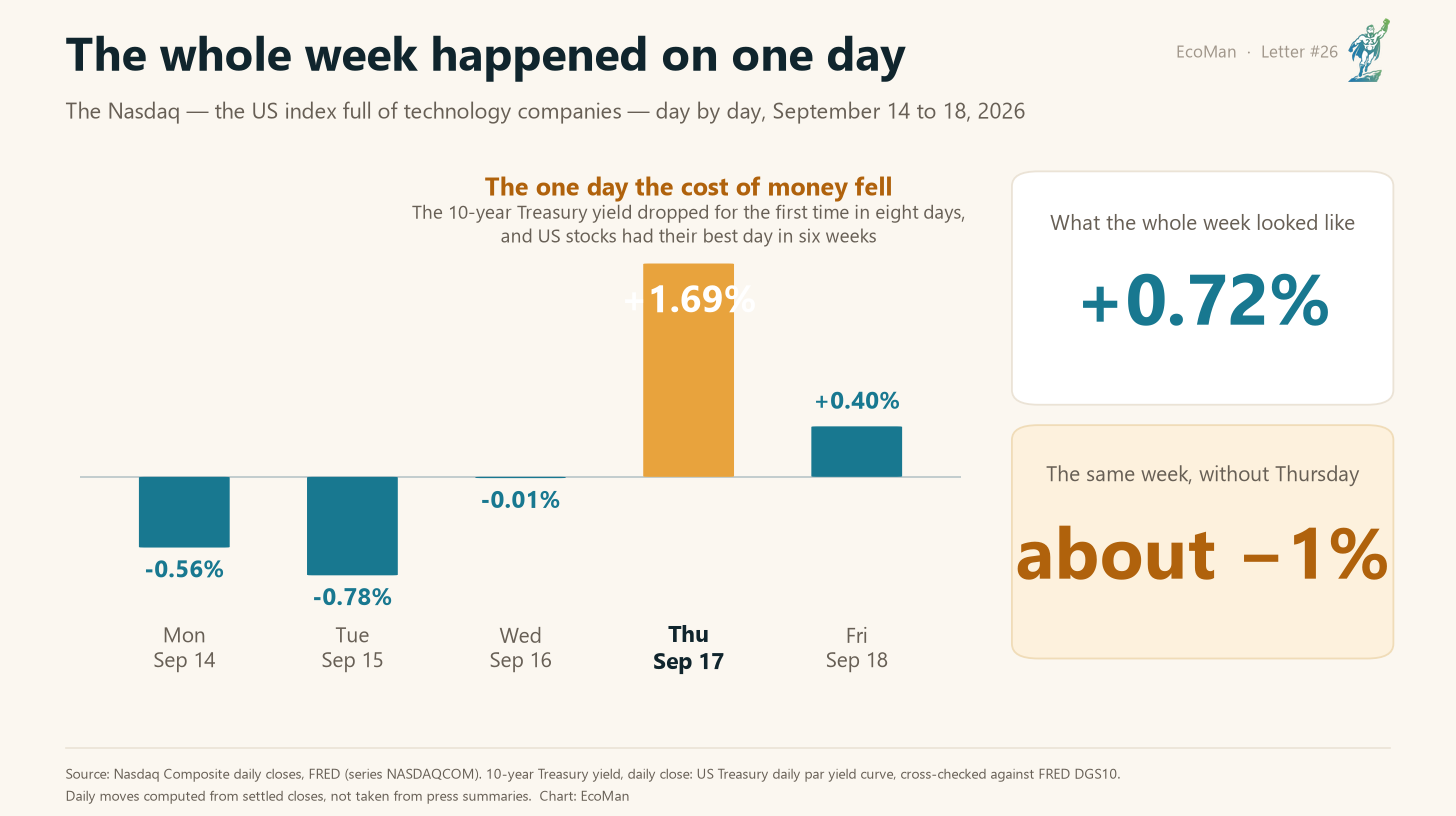
Let's start with what looks like a contradiction. I explained above that rising rates hurt hardest the companies whose profits are furthest away, and yet the Nasdaq finished the week up 0.7%. The answer isn't in the weekly summary but in the daily path. Through Wednesday's close the index was down 1.4% on the week, and it fell on each of the three days the ten-year yield climbed in a row — from 4.96% to 4.97%, on to 5.00%, and on to 5.01%. Then, on Thursday, the yield fell by 0.07 of a percentage point, its first fall after eight straight sessions of rising, three of them this week, and the index rose 1.7% in one day — more than double its entire gain for the week. Without Thursday it closes the week down about a percent. There is no contradiction here, just the same rule running in the opposite direction.
And why did the yield fall on Thursday? Because oil fell, after Saudi Arabia reported progress on repairing the pipeline that was knocked out on the 10th of September. Which is exactly the line we opened with, only reversed: the price of money fell because the price of energy fell. That day the chip index rose 3.1%, and that same index, which had dropped 5.9% on Monday, finished the entire week up 0.8% — its whole recovery compressed into two days, Thursday and Friday, right after the run of rising yields broke. The market fell on each of the three days of that climbing streak, and on the day the streak broke — because oil fell — it had its best day in six weeks.
And the S&P 500 (the index of the 500 largest US companies) finished flat, down 0.1%, because the two sides cancelled each other out. Of the eleven sectors in the US market only two rose — health care up 1.8% and technology up 1.0% — and nine fell, led by the three most sensitive to interest rates: utilities down 3.0%, financials down 2.4%, and real estate down 2.1%. Technology, which is more than a third of the index, together with health care, carried about half a percent — and the other nine sectors took it back. At the same time the gap between short-term and long-term interest rates narrowed by about 0.08 of a percentage point. The mechanism is simple: the short rate follows the central bank almost one for one, so when the market expects more hikes soon it climbs and closes on the long rate, which priced that story in long ago. And the bottom line is that anyone looking only at the broad index sees a week in which nothing happened — while inside it, utilities, financials and real estate took the hit.
This whole week got me thinking again about the meaning of connected vessels, and how they end up affecting our money. What runs faster — the technology that improves profitability, or the growing challenge of global debt and rising rates? Which of them matters tomorrow morning? I wrote about exactly that race in the letter on the US debt, and I recommend jumping over to it: The Debt Crossed $40 Trillion, and the Borrower Started Buying Itself Back. Throughout history (the history I know, at least), and by my own experience over the past three decades, the alternative interest rate has always been a "wall" that makes profitability in assets like stocks very hard, and one that can also kill, or at least delay, technological development by drying up the wells of financing. But at this particular moment, and history will forgive me the phrase "this time is different," the way they explained it to us at the end of the 1990s (and were wrong), I have a feeling that the exponential run of these technologies forward is so fast and so powerful that even an alternative interest rate that keeps climbing will not manage to stop it any time soon.
We shall see.
See you in next week's letter, or during the week — if I can't help myself until then...