


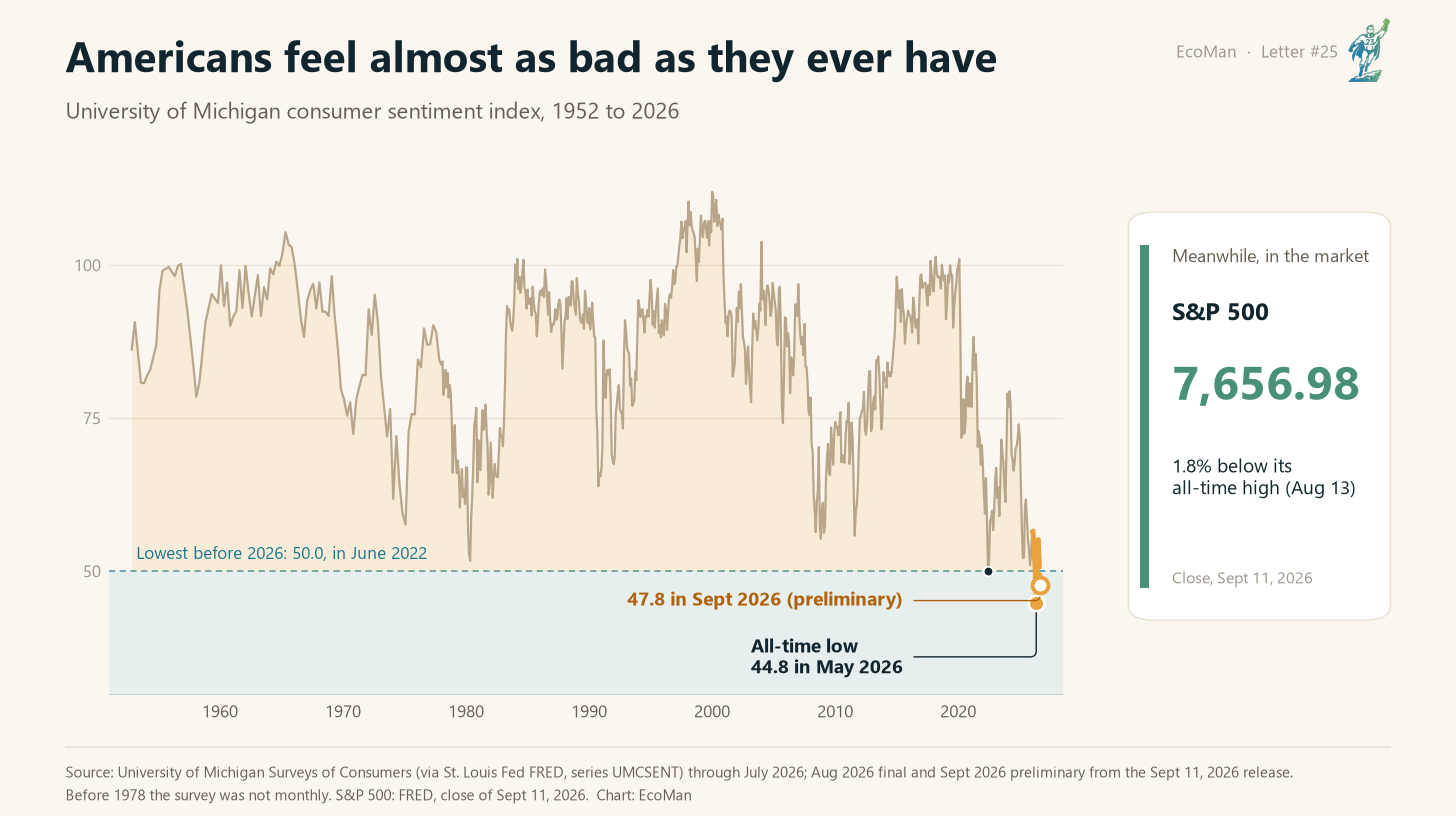
On Friday, the University of Michigan published its September consumer sentiment index (a monthly survey that asks thousands of Americans how they feel about their own finances and about the country's economy), and it fell to 47.8, from 51.7 in August (a reading below 50, in plain language, means people are feeling pretty down). If that reading holds when the final number comes out at the end of the month, it will be the second-lowest since the survey began in 1952 — with the lowest recorded just this May. On the day it came out, the S&P 500 (the index of the 500 largest US companies) closed up almost 12% for the year, less than 2% below the all-time high it set in mid-August. Both numbers are true, in the same week, and they describe (seemingly) two different countries.
From what I've seen in recent years, the first explanation that comes to mind for a gap like this is the giants. The S&P 500 is weighted by market value (meaning that a company worth ten times more than another stock in the index will also move the index ten times as much), so a handful of enormous tech companies can lift it on their own while most other stocks go nowhere. That was very much the story of 2023 and 2024, so it's the explanation I expected to find again. I checked, and it doesn't hold. There is a version of the same index in which every company counts exactly the same, and this year it is up 11.9% — exactly as much as the regular index. Smaller companies did even better, up 17%. In other words, this year's rise wasn't carried by a few giants — the average stock rose just as much as the index did.
The second explanation I checked is political — that in a divided country, people answer surveys according to who sits in the White House, and not necessarily according to what's happening in their wallet. That doesn't explain this month either, because sentiment fell among Democrats and Republicans alike. So what does? Start with what Americans actually met this week, which isn't the index but the gas station. On September 13 the national average for a gallon of regular was $4.31, against $3.18 a year earlier — more than a third higher, with about 17 cents of that added in the past week alone, amid the tension around the Strait of Hormuz. Someone who fills up twice a week feels that before any other number, and it's no surprise that Americans now expect prices to rise 4.6% over the next 12 months, up from the 4.0% they expected just a month ago.
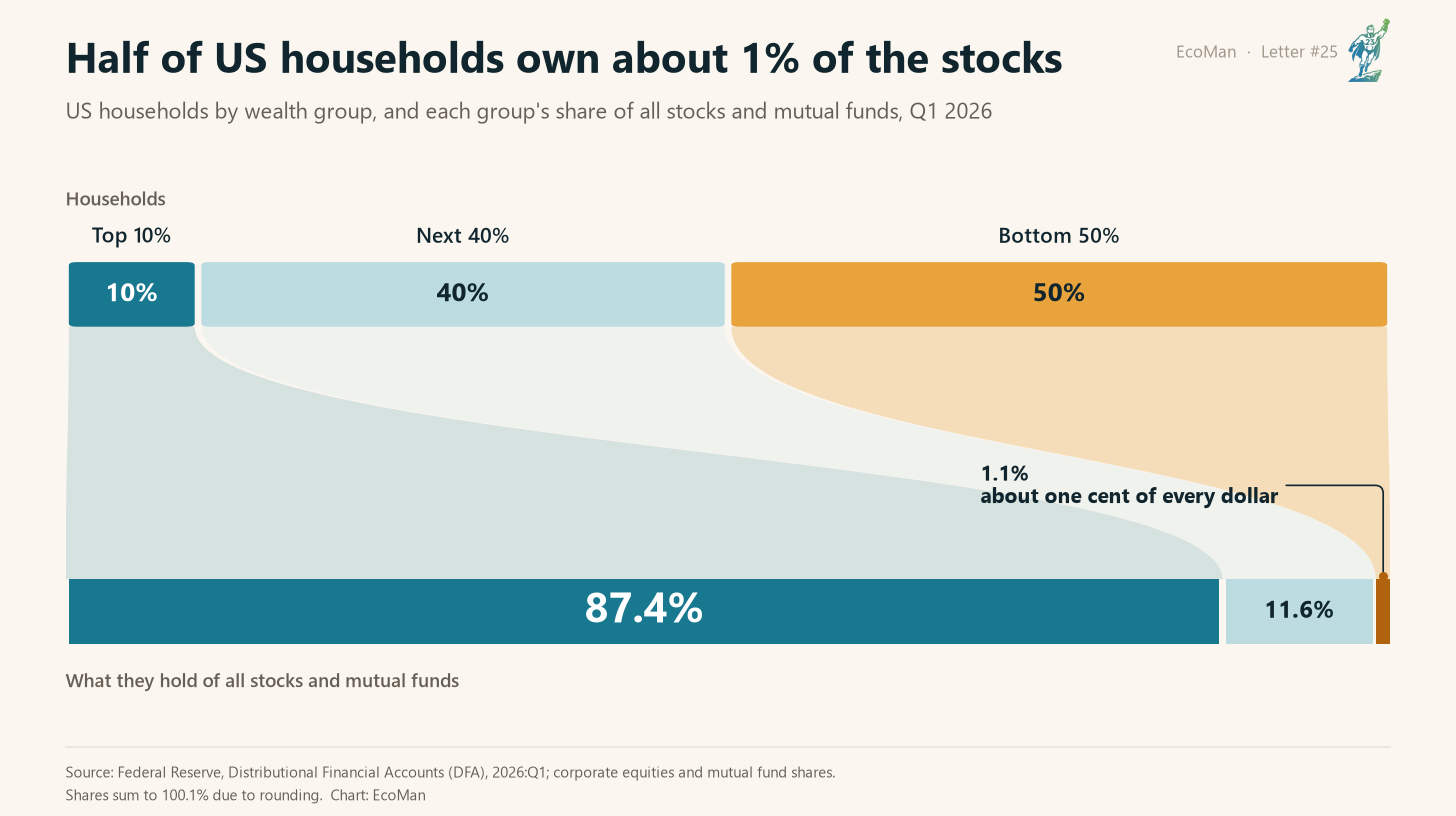
So we understand the gloom. The question that comes up at this point is this: if most stocks went up (which usually triggers what's known as the wealth effect — people feel richer day to day, and spend more day to day, even when the only thing that changed is the value of their investment portfolio), why doesn't that make up for it? And the answer is that a rising market only makes you richer if you own a piece of it, and most Americans own almost none. Every quarter, the Federal Reserve publishes who holds the country's wealth, layer by layer. In the latest figures, for the first quarter of 2026, the top 10% of households hold 87% of all the stocks and mutual funds in the country, while the bottom half of households, all of them together, hold about 1% — roughly one cent of every dollar invested in the market. So a 12% rise is a real and broad rise, and it simply doesn't reach most people, because they have nothing in the market for it to lift. That is how you get, in the same week, an index flirting with a record and a public stuck in a slump.
The University of Michigan sees exactly this in its own data. It splits its answers by stock ownership, and in its February report this year it noted that sentiment surged among consumers with the largest stock portfolios, while those without stocks stayed at dismal levels. Same economy, same survey, two opposite answers, depending only on what you have put aside. I already wrote about this kind of split in Letter #08, when it showed up in the job market — knowledge jobs disappearing while lower-paid service jobs were being added. Here the same polarization shows up on the other side of the ledger, in the question of who owns the capital.
What does this mean for your pocket?
Every time you hear that the market is at a record, it's worth asking two questions. The first is what exactly went up. The regular index can rise on the back of a few giants, and the way to check is to look at its equal-weight version (the one where every company counts the same); this year the answer was "the average stock did as well as the giants," while in 2023 and 2024 it was "mostly the biggest." The second is whose money it is. A rise in the market is a rise in the money of those who hold the market, not in everyone's money, and the headline will never tell you which side of that line you are on.
For readers in Israel there is one more layer. Many of you hold the S&P 500 through an index fund (meaning a fund that buys every stock in the index, in exactly the same proportions) or through a provident fund or study fund track that follows it. But you measure those savings in shekels, and the shekel strengthened this year: the dollar fell from 3.19 shekels at the end of December to about 3.02 last week. So a gain of almost 12% in dollars shrank to about 6% in shekels (before fees, and without currency hedging) — about half the gain was lost on the way home. That isn't a loss, but it is a reminder that an Israeli investor in American stocks always has two numbers to check: what the index did, and what the shekel did.
So who is right, the market or the public? Personally, I think both are reporting accurately on what each of them sees: the market is pricing companies, and the public is pricing its week, at the pump and at the supermarket checkout. What stays with me from this week is simpler than a verdict between them. The question that matters isn't which of the two is wrong, but which side of the line you stand on — and if your own feeling this week didn't match the headlines, in my view that isn't a sign you missed something. It simply shows where you stand in the standings...
We shall see.
See you in next week's letter, or during the week — if I can't help myself until then...